


- Climate change
The Basque Country plays host to twelve European regions at the forefront of climate change adaptation policies in Irun
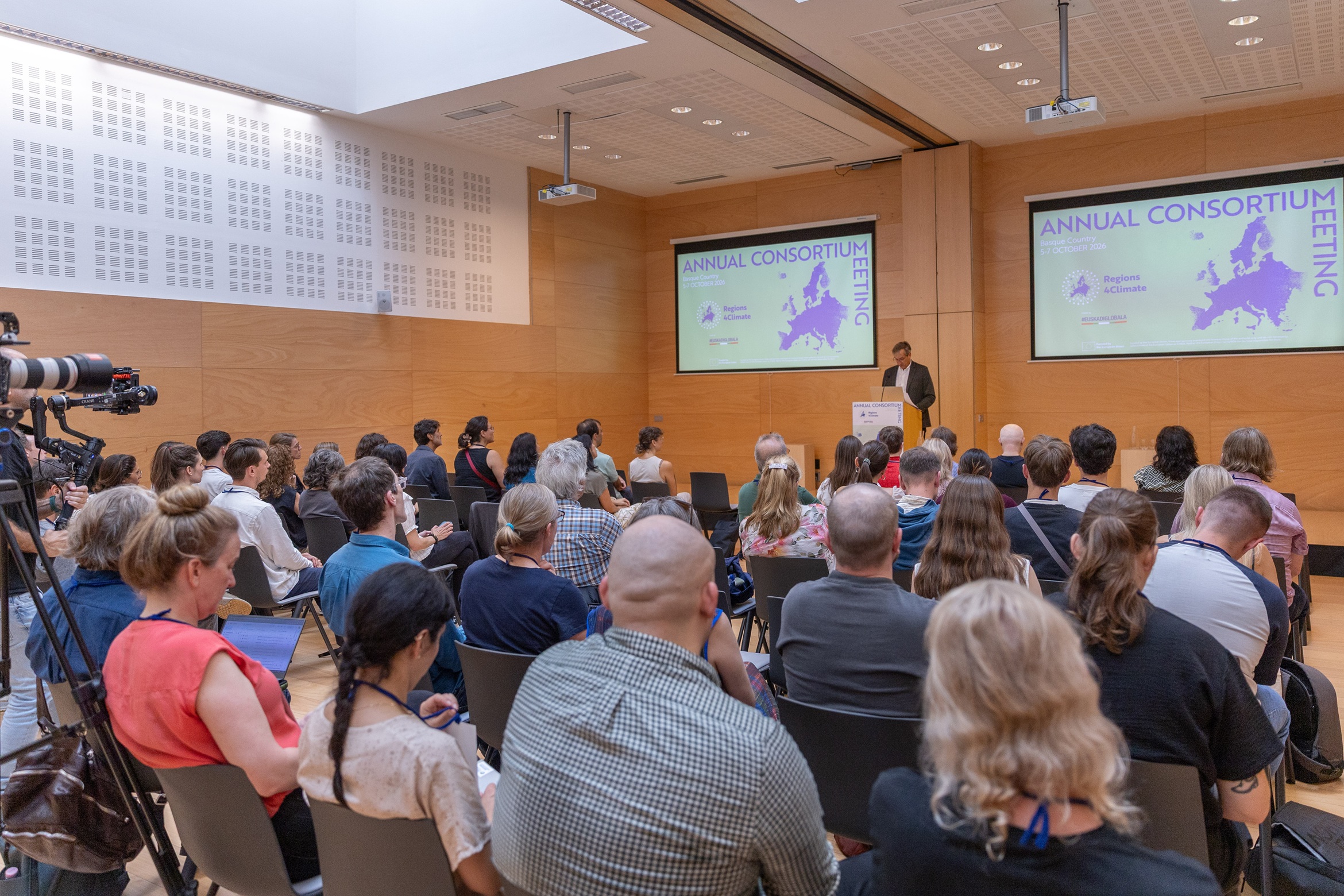
The Basque Country will host the fourth annual meeting of the European (Regions4Climate (R4C) project in Irun from today up to October 7, an initiative funded by the Horizon Europe programme that promotes innovative solutions to increase the resilience of European regions to climate change. The event brings together representatives from the twelve regions taking part in the project, as well as European science and technology organisations and public authorities.
Ficoba will host the fourth meeting of the Regions4Climate consortium between October 5 and 7, a European project expected to benefit more than 13.8 million people in those regions by 2027.
During the official opening ceremony, Adolfo Uriarte, Director of the Basque Government’s Department of Natural Heritage and Climate Change Adaptation, stressed the value of regional collaboration when it comes to tackling climate risks: “Faced with a global challenge, no region can act alone. We need shared knowledge, innovation, institutional cooperation and social commitment. We need to become more resilient together, learning from one another and moving forward as a European community committed to protecting people and our regions”.
The current situation calls for urgent action. This year, the Basque Country recorded the warmest summer on record, with an average temperature of 22.1 °C, 3.4 °C above the expected climate average. In the sea, record temperatures in the Bay of Biscay reached peaks of over 26 °C along the Basque coast, with unprecedented temperature anomalies of over 3 °C above the usual temperature, averaging 23.4 °C. And, between 2000 and 2024, the average sea level has risen by between 15 and 25 centimetres along the Basque coast.
The Basque Country is leading the working group on coastal adaptation, with its main pilot project centred on Txingudi Bay
In this regard, Uriarte highlighted the role that the regions are already playing in the search for solutions that can be applied to their own regions: “The most important thing is that we are demonstrating that climate adaptation is not just an abstract idea. It is something tangible. It is something that can be measured. And it is something that can be replicated,” he said.
Holding this consortium meeting in the Basque Country is an acknowledgement of the work carried out in the region in the field of climate adaptation and will provide an opportunity to showcase some of the actions currently being implemented in Txingudi Bay to increase the resilience of the Basque coastline.
Twelve European regions working together to tackle a common challenge
Regions4Climate is made up of twelve European regions: Basque Country, Castile and León (Spain), Nouvelle-Aquitaine (France), the Azores (Portugal), Tuscany (Italy), Pärnumaa (Estonia), Helsinki-Uusimaa, the Nordic Archipelago (Finland), Burgas (Bulgaria), Sitia (Greece), Cyprus and Køge Bay (Denmark). They are all working together to design and demonstrate innovative solutions to tackle the impacts of climate change in areas such as water management, coastal adaptation, ecosystems, climate governance and social participation.
On October 7, representatives from Castile and León (Spain), Nouvelle-Aquitaine (France), the Azores (Portugal), Tuscany (Italy), Pärnumaa (Estonia), Helsinki-Uusimaa and the Nordic Archipelago (Finland), Burgas (Bulgaria), Sitia (Greece), Cyprus and Køge Bay (Denmark) will be able to visit the restored areas around the San Lorenzo lagoon and the Jaizubia wetlands
The project, which is running from 2023 to 2027, has received European funding of over 24.5 million euros, and it is estimated that more than 13.8 million people may benefit from the tools, knowledge and solutions developed as part of the initiative.
Txingudi, a Basque coastal adaptation demonstration project
The Basque Country is taking part as the lead region in the working group focusing on coastal adaptation, working alongside Nouvelle-Aquitaine, the Azores and Tuscany to develop solutions to risks such as rising sea levels, coastal erosion, flooding and storms.
The main Basque initiative within the project is being carried out in Txingudi Bay, specifically in the area around the San Lorenzo lagoon and the Jaizubia wetlands. The actions planned will help to restore the natural dynamics of these areas, improve biodiversity and strengthen their ability to adapt to the effects of climate change.
In total, the project will recover and monitor 5.5 hectares in San Lorenzo, and 2.5 hectares of wetland restored in Jaizubia. These actions will be complemented by an advanced scientific monitoring system that will make it possible to assess how ecosystems evolve and measure the effectiveness of nature-based solutions implemented in the Bidasoa estuary.
Science, governance and participation
The Basque contribution to Regions4Climate also includes the development of new tools for governance and institutional coordination. These include the KAIA interdepartmental working group, which was set up to promote climate adaptation by getting different departments of the Basque Government and specialist organisations working in the fields of water and flood management, meteorology, spatial planning, emergency response and natural heritage to work together.
The project has also helped to strengthen public participation in the Txingudi area through initiatives carried out in collaboration with Ekoetxea Txingudi, and has made progress in generating scientific knowledge and tools that can be applied to other European regions facing similar challenges.
The consortium meeting / gathering… will combine working sessions with technical visits to various sites in the Basque Country and Nouvelle-Aquitaine, where the regions involved will be able to gain first-hand insight into the actions relating to the ecological restoration, coastal monitoring and climate adaptation carried out in both regions.
Source: Ihobe


