


The most pressing enviromental challenge
Climate change is one of the most pressing environmental challenges that all the nations of the planet have to face. The UN Intergovernmental Panel on Climate Change (IPCC) has pointed out that the global warming of the atmosphere registered since the middle of the 20th century has been caused by human activity.
In the last 150 years, the global temperature has risen approximately 0.8 ºC and it is foreseen that it will continue to do so. There changes in the climate are having direct consequences in sectors such as farming, forestry, energy production, tourism and infrastructures in general
One of the most vulnerable regions to the direct impacts of climate change is southern Europe, which is experiencing rises in temperature, floods or droughts.
In the Basque Country, greenhouse gas emissions (GHG emissions), causing climate change, rose 1% in 2015 compared to the previous year. In relation to 2005, the emissions fell by 25% and were slightly under the path set to achieve the targets of the Basque Climate Change Strategy - KLIMA2050, which establishes a reduction target of 40% for 2030.


What are
Urban climate shelters are public (and in some cases private) spaces that provide safe and pleasant thermal conditions during high temperature events. Their aim is to protect the population from the effects of extreme heat, especially the most vulnerable groups, such as the elderly, children or the homeless.
These spaces may be indoor (such as libraries, civic centres or air conditioned shopping malls) or outdoor (shaded parks, squares with greenery or fountains, etc.).
This is a preventive and climate change adaptation measure that enables people to find heat relief at strategic points in the municipality, without the need for additional resources or costly interventions.

Why are necessary
Climate change is causing an increase in the frequency, duration and intensity of heat waves. These episodes affect the population unequally, whereby the most vulnerable (the elderly, children, people with chronic illnesses or in situations of energy poverty) suffer the most.
Climate shelters are part of cities' adaptation strategies to ensure climate equity and strengthen urban resilience.
What conditions
To be considered a climatic shelter, a space must meet the following conditions as a minimum:
- Universal accessibility: adapted for people with reduced mobility.
- Free and open access.
- Close location: within 10 minutes walking distance.
- Thermal comfort:
· Indoors: temperature below 26 °C.
· Outdoors: shaded areas with vegetation and natural ventilation.
- Appropriate opening hours: open in the warmer months (May to October), especially in the middle of the day.
- Basic services: such as drinking water, rest areas and toilets.
- Clear signage: so that anyone can easily identify them.
How they are identified
The inventory of climatic shelters is a process that can be approached from methodological approaches of greater or lesser complexity and automatism, which will depend mainly on the size of the municipality, on the human and economic resources available for the work, and on the information available.
The methodological process can be structured in three sequential steps that include identification, characterization and representation or mapping for its subsequent dissemination.
At Ihobe we have prepared this check list to facilitate municipalities in the identification and characterization of climatic shelters.
STEP 1: Information gathering
For this, the following have been taken into account:
- Local climate data
- Surface materials and vegetation cover
- Shadows projected in the case of outdoor spaces
- Indoor temperature in buildings and enclosed premises
- Available resources: drinking water, toilets, areas for staying or resting
STEP 2: Characterization and selection
Two blocks of variables have been defined: physical characteristics and equipment/services available.
Physical characteristics:
- Adapted accessibility
- Comfortable access (adequate pedestrian route)
- Free and open access
- Available vegetation cover
- Opening (months and hours)
Available equipment and services:
- Toilets
- Drinking water
- Area for staying or resting
- Defibrillator
- Other complementary resources
STEP 3: Mapping and location
Finally, the location or neighbourhood of each identified point is recorded in order to trace viable itineraries between the spaces with the best thermal comfort conditions.
Types of shelters
- Outdoor shelters:
- Shaded parks and squares
- School playgrounds
- Arches
- Outdoor municipal swimming pools
- Squares with fountains or water features
- Areas under bridges
- Urban forests and green belts
- Indoor shelters:
- Libraries and play centres
- Civic centres and cultural centres
- Schools
- Municipal buildings
- Sports centres
- Museums and exhibition halls
- Social centres (such as the Nagusien Etxeak)
- Transport stations
- Churches
- Shopping centres
Location
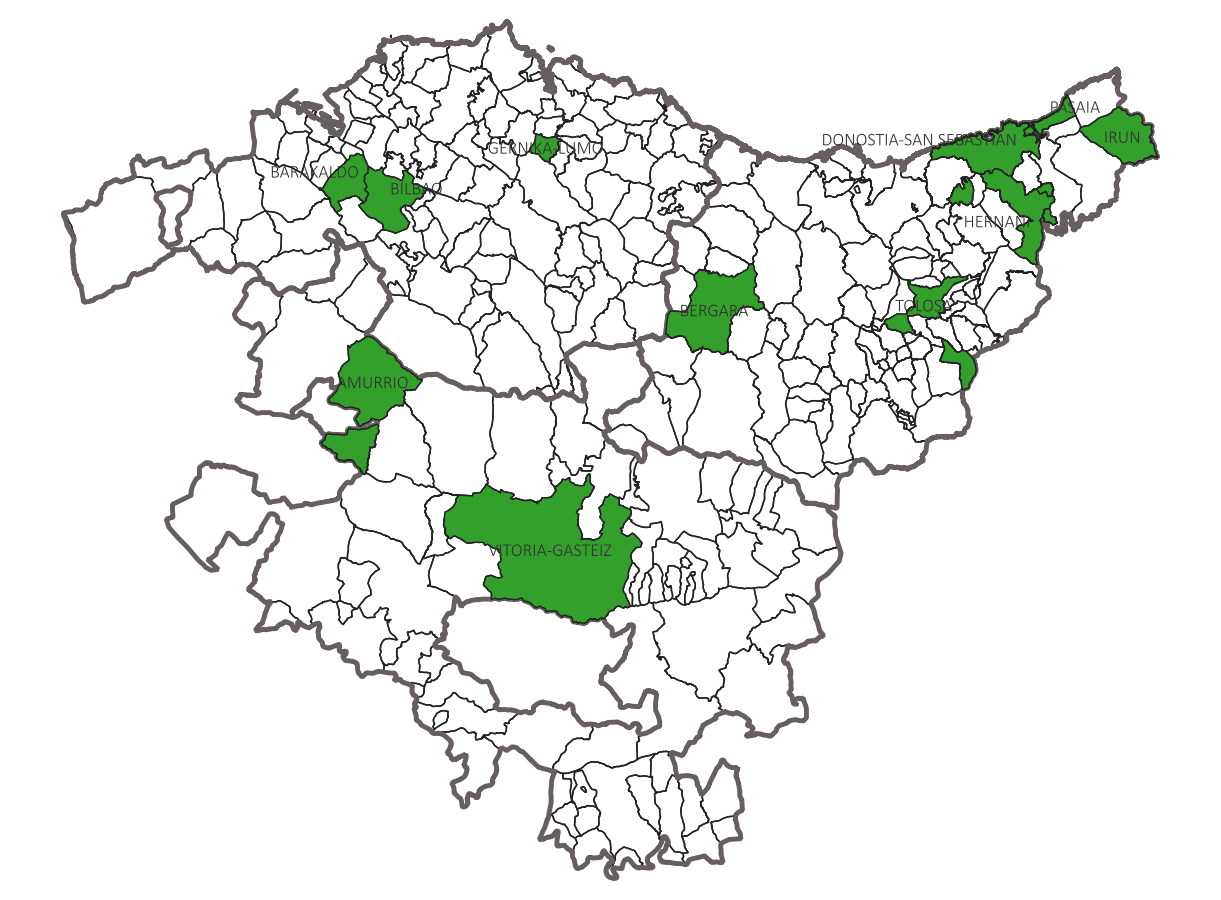
In the Basque Country, many climate shelters have already been identified in the different municipalities. These spaces are part of a network that enables anyone, regardless of age or condition, to find a safe and cool place close to home.
The shelters have been selected and mapped with the collaboration of the local authorities, taking into account technical criteria of accessibility, thermal comfort and proximity.
These spaces will be accessible to citizens through clear signage and maps available on digital platforms, especially during heat alert periods, in coordination with civil protection and public health plans.
Find your shelter
For more information about the location of climatic shelters, to know the latest updates and the most recent information, visit the following links:

Since February 2024, the Basque Country has relied on the Basque Law on Energy Transition and Climate Change to facilitate alignment with all the regulations, policies and plans to which the Basque Country has expressed its commitment and adherence, and which aim to achieve neutrality, resilience and a just transition by 2050.
Law 1/2024 on Energy Transition and Climate Change aims to establish the stable legal framework to achieve climate neutrality in the Basque Country by 2050 at the latest, a commitment made in the Paris Agreement, and to increase the resilience of its territory to climate change, through a fair and sustainable social, economic and environmental transition that guarantees equity and solidarity.
Climate Change Strategy of the Basque Country - KLIMA2050
The action of the Basque Country against climate change addresses two fundamental areas, mitigation and adaptation. The Climate Change Strategy of the Basque Country - KLIMA2050 approaches the environmental challenge of climate change from an overall view where all sectoral policies must integrate the climate change variable. This integral approach means that the courses of action by the different ministries of the Basque Government will be implemented at local and regional level in all sectors of activity. All the actions envisaged in the framework of the strategy are in keeping with EU endeavours and horizons in this area.
The strategy sets 9 goals which include:
- Commitment to a low-carbon energy model
- Zero emission transport
- Increased efficiency and resilience of the territory and of the natural environment
- Driving innovation
- Improving and transferring knowledge.
A total of 24 lines of actions in the industry, transport, energy and waste sectors, among others, to meet the goals.

The application of this strategy will ensure that the Basque Country cuts its greenhouse gas emissions by 80% by 2050, with respect to 2005 emissions. Furthermore, and thanks to the development of renewable energies and the spread of energy efficiency technologies, the energy and industrial sectors are expected to reach reductions of 50%. Furthermore, 40% renewable energy consumption out of the final consumption is expected to be reached by 2050.

KLIMA2050 Goals and Lines of Action
Goal 1. Committing to a low-carbon energy model
Lines of action:
- Improving energy efficiency and managing energy demand.
- Giving impetus to renewable energies.
- Fostering energy efficiency criteria and renewable energies in the urban environment towards "zero-emissions building"
Goal 2. Moving towards zero-emissions transport
Lines of action:
- Fostering intermodality and means of transport with lower GHG emissions
- Replacing the use of oil derivatives.
- Integrating vulnerability criteria and adaptation criteria into transport infrastructures.
Goal 3. Increasing the efficiency and resilience of the territory
Lines of action:
- Driving an urban structure that is resilient to climate change, compact and with a mix of uses.
- Integrating vulnerability analysis and adaptation to climate change in the territorial strategy.
Goal 4. Making the natural environment more resilient
Lines of action:
- Fostering the multifunctionality of ecosystems as regulators of geological and biological processes.
- Integrating the climate change variable in the management of coastal zones.
Goal 5. Making the primary sector more resilient and cutting its emissions
Lines of action:
- Fostering local, organic and integrated agricultural production and with lower GHG emissions
- Increasing the potential of the Basque Country as a carbon sink.
- Adapting the practices and managing the primary sector to the new climate conditions
Goal 6. Reducing the amount of municipal solid waste generated and zero untreated waste dumping
Lines of action:
- Reducing the generation of municipal solid waste.
- Increasing the selective collection and sorting ratios and their subsequent reuse, recycling and recovery.
Goal 7. Anticipating the risks
Lines of action:
- Guaranteeing the long-term water supply for different uses.
- Ensuring the resilience of the built environment and of the critical infrastructures (energy, water, food, health and ICTs) to extreme events.
Goal 8. Driving innovation, improvement and knowledge transfer
Lines of action:
- Promoting innovation, improving and transferring scientific knowledge.
- Implementing a system to monitor and follow the effects of climate change.
Goal 9. Exemplary and responsible Basque public administration and which is a benchmark in climate change
Lines of action:
- Organising training measures to acquire skills and expertise regarding climate change.
- Awareness-raising, training and informing the general public about climate change.
- Zero emissions public administration.
- Consolidating inter-institutional coordination mechanisms for climate action.
- Positioning the Basque Country on the international stage regarding climate change


About

Approved by the European Union within the area of LIFE Integrated climate change mitigation and/or adaptation projects, its main objective is to promote the energy and climate transition in order to increase the resilience of the Basque Country through the development of a total of 40 actions, that can be replicated in other areas of the Basque Country and the European Union.
It is led by Ihobe, the Public Environmental Management Company attached to the Basque Government’s Department of Industry Development, Energy Transition and Sustainability, with the participation of 23 organisations and entities.

- 7 years duration until 2026
- €19.8 million investment
- 70% of the budget implemented
- 80% of planned actions under development
- 10% of planned actions completed
Download the Progress Reports
About

Impulsado por la colaboración entre seis regiones europeas, entre ellas Euskadi, el proyecto LIFE OCTOPUS promoverá la transición energética y climática empoderando a las autoridades locales y regionales y a las agencias de energía y de medio ambiente para que desarrollen e implementen soluciones innovadoras en este ámbito y adaptadas a sus regiones. Junto a Euskadi, en el que las entidades sociales son Ihobe y el Ente Vasco de la Energía (EVE), participan Extremadura, la República de Chipre, la región polaca Voivodato de Mazovia, la región checa de Usti y las francesas Auvernia-Ródano-Alpes e Isère.
Driven by the partnership between six European regions, and including the Basque Country, the LIFE OCTOPUS project will foster the energy and climate transition by empowering regional and local authorities and environmental and energy agencies to develop and roll out innovative solutions in this field and adapted to their regions. Extremadura, the Republic of Cyprus, the Mazovian Voivodeship region in Poland, the Usti Region in Czechia, and the French regions of Auvergne-Rhône-Alpes and Isère are taking part along with the Basque Country, where Ihobe and the Basque Energy Board (EVE) are the partners.
OCTOPUS will create and strengthen seven Enabling Organisational Networks (EON), designed to connect local stakeholders with the regional government, in order to achieve its goal. The EONs will play a fundamental role for a faster rolling out of the Local Climate and Energy Plans

The Basque Country is one of the regions that already has its network. In its case, OCTOPUS will be rolled out through Udalsarea 2030, the network of sustainable municipalities with a proven track record of over 20 years that position the Basque Country as one of the most advanced regions in Europe.
The project will drive cooperation, and the EONs will act as centres to share knowledge and develop capacity-building and strategies that facilitate compliance with the energy and climate goals of the European Union. Thus, the stakeholders will be provided with tools, guidance and best practices to overcome barriers such as limited resources, obsolete strategies and lack of cooperation between the different levels of governance, by means of pilot activities and specific support.
OCTOPUS will last for 36 months, during which the EON's role will be to accelerate the implementation of the local climate and energy plans and actions, by facilitating compliance of the climate and energy goals of the regions involved and those taking part in the replication activities.
In turn, Udalsarea 2030, which already has extensive experience, will seek to bolster the support, tools, service and information that it offers municipalities thanks to the project. Thus, solutions will be sought that are not only innovative, but also scalable, equitable and which meet local needs.
Partners
The LIFE OCTOPUS project gathers together over a dozen organisations working together in coordination:
Coordinated by: Auvergne-Rhône-Alpes Energy Environment Agency
Entidades socias
 Auvergne-Rhône-Alpes Energy Environment Agency
 Association Pour Une Gestion Durable De L' Energie
 Ente Vasco De La Energía (EVE)
 Ihobe, Sociedad Publica De Gestion Ambiental del Gobierno Vasco
 Consorcio Agencia Extremena De La Energía
 Mazowiecka Agencja Energetyczna Spzoo
 Energeticke Centrum Usteckeho Kraje


