


- Climate change
Basque Country shares strategy to support Basque municipalities in energy and climate transition at Climate Summit
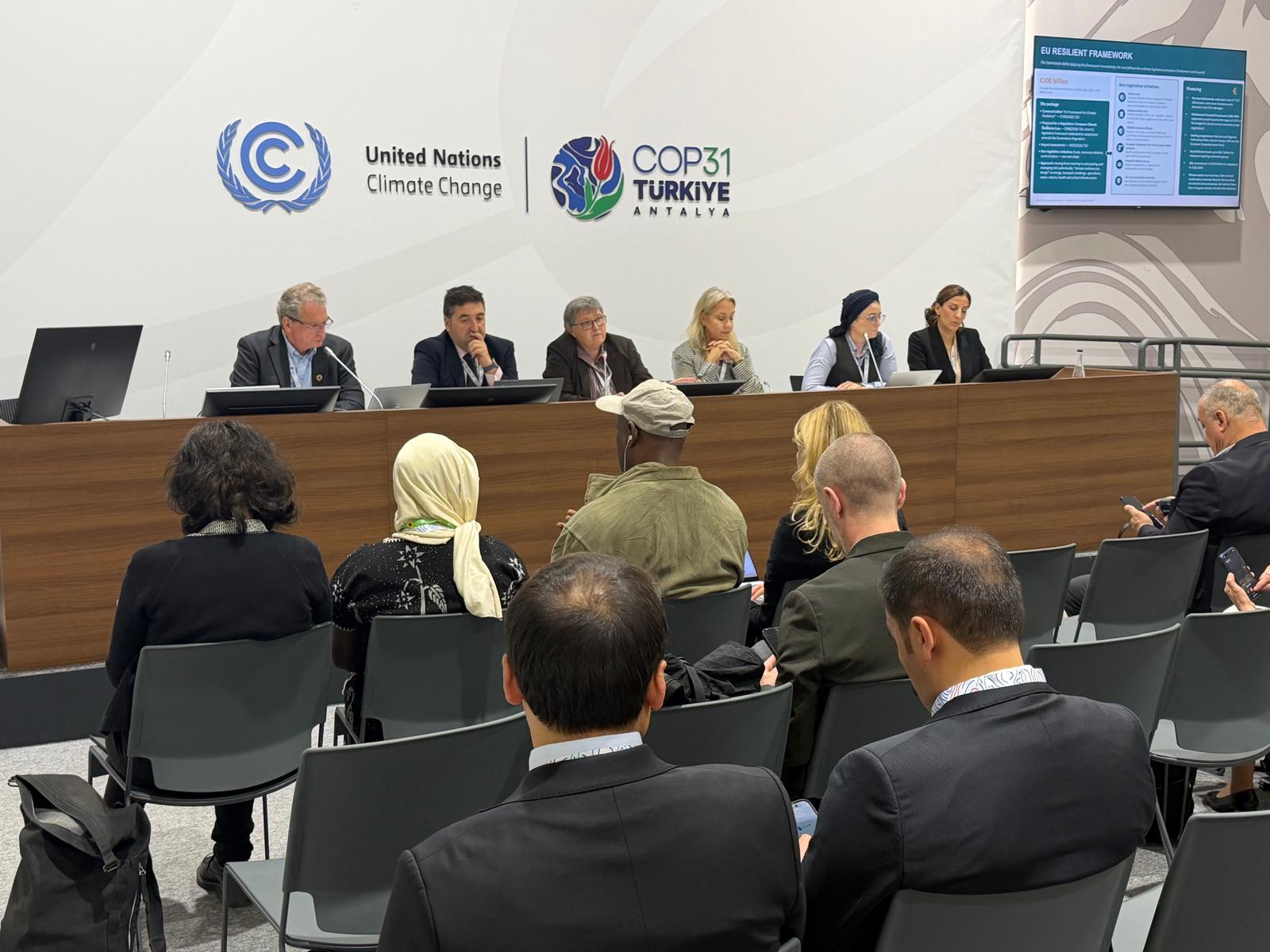
At COP31, the Basque Government today shared its strategy to support and assist municipalities in working towards energy and climate transition, a model which combines planning, funding, capacity generation and tools allowing action to combat climate change to be implemented through specific initiatives on the ground. The strategy was explained by the Vice-Minister for the Environment, Josu Bilbao, at the event "Just Transition: empowering local governments and communities", organised by BC3 within the context of the Antalya Climate Summit.
The Basque Government has brought its local climate action model to COP31, based on planning, funding and support for town councils and local authorities in developing more resilient and decarbonised municipalities
The Basque experience is based on the conviction that the energy and climate transition can only be seen as just if it extends to all territories, and takes different local realities into account. The Basque Country Climate and Energy Plans specifically integrate mitigation, adaptation and just transition, including such spheres as protection for vulnerable groups and energy poverty, skills development and green employment, and the promotion of green financial instruments.
140 municipalities planning their energy and climate transition
According to the most recent data available from the Basque Network of Sustainable Municipalities-Udalsarea 2030, 140 Basque municipalities have a Climate and Energy Plan in place, or are currently drafting their text. Of these, 69 have already been approved, while another 71 have the process under way.
140 Basque municipalities already have a Climate and Energy Plan, or are working on theirs: 69 have received approval and 71 are currently pending
Energy Transition and Climate Change Act 1/2024 establishes that municipalities in the Basque Country with a population of over 5,000 must have Climate and Energy Plans in place. These instruments offer an integrated approach to emissions mitigation, adaptation to the impacts of climate change and just transition, adopting an overview of each municipality.
This process goes hand-in-hand with the Mayoral Pact for Climate and Energy. The most recent localised data record 51 Basque municipalities which have signed up, and another eight in the process of doing so.
Four million euros to transform the territory from the grass roots
Funding is another of the essential instruments employed by this policy to support town councils and local authorities. The Basque Government recently issued a new Order setting out grants for sustainability projects instigated by local authorities, assigning a budget of 4 million euros, the largest in recent years. This is a 54% increase on the previous funding round, to allow larger-scale ventures and greater environmental impact.
The Basque agenda on 10 November is rounded off with a presentation of the BIK 2050 digital twin at a session on artificial intelligence, while in the afternoon, the delegation will be taking part at the 10th anniversary of the RegionsAdapt initiative
The funding is intended to support initiatives that help make municipalities more resilient, sustainable, and better prepared to address climate change and biodiversity loss. The applications period runs from 30 October to 30 November 2026.
The Basque Government has just announced a new call for grants to local authorities, with a budget of 4 million euros, the largest in recent years and almost 54% higher than the previous round
The Basque Government has, since 2007, deployed 76 million euros to assist municipalities in environmental matters. The commitment to reinforce such instruments is likewise based on concrete results: the 165 initiatives funded in response to the previous year's call are generating environmental benefits in the form of 1,500 tonnes of CO₂ absorbed, over 150,000 m² of degraded land restored, and almost 64 hectares of natural habitats upgraded.
The impact can also be seen in projects specifically linked to climate action. Following the most recent funding round, there has been an increase of over 8,300 m² of new permeable urban land, along with 7,200 trees planted in reforesting more than 12 hectares, the associated CO₂ capture amounting to 1,415 tonnes.
Artificial intelligence to anticipate climate risks
The Basque delegation's agenda at COP31 for 10 November also includes involvement by Adolfo Uriarte, the Basque Government's Director of Natural Heritage and Climate Change Adaptation, at the gathering "Using artificial intelligence to power climate data, grid management and climate finance", organised by BBVA.
Adolfo Uriarte presented the design of the digital twin of the Nervión estuary, intended to integrate information on climate scenarios, early warning systems and modelling within a platform which will serve to improve decision-making and reduce climate risks in Metropolitan Bilbao. The project exemplifies the Basque commitment to combining governance, knowledge and technology with specific adaptation measures, within the context of the project Bilbao Itsasadarra eta Klima-BIK 2050.
The Basque Country at the 10th anniversary of RegionsAdapt
In the afternoon, the Basque Government delegation will be taking part in the celebrations to mark the 10th anniversary of RegionsAdapt, organised by the international Regions4 network. Their involvement will allow the Basque Country to share its experience, while at the same time addressing the future of cooperation among regional governments to address climate change.
RegionsAdapt was first founded in 2015 during COP21 in Paris, and in parallel with the adoption of the Paris Agreement, as the first global initiative focused specifically on supporting subnational governments in adapting to climate change. The Basque Country has belonged to this movement from the outset, along with the group of regions behind its initial commitments.
A decade later, RegionsAdapt brings together more than 85 states and regions, representing over 470 million people. Since 2021, 46 regions, including the Basque Country, have implemented 328 adaptation initiatives.
Source: Ihobe


