


07
dec
2023
The Basque Country showcases nature-based solutions at COP28 as an essential tool for climate action
The Basque Country is the current chair of Regions4, the international network that supports regions worldwide to intensify their climate action commitments and adaptation plans.
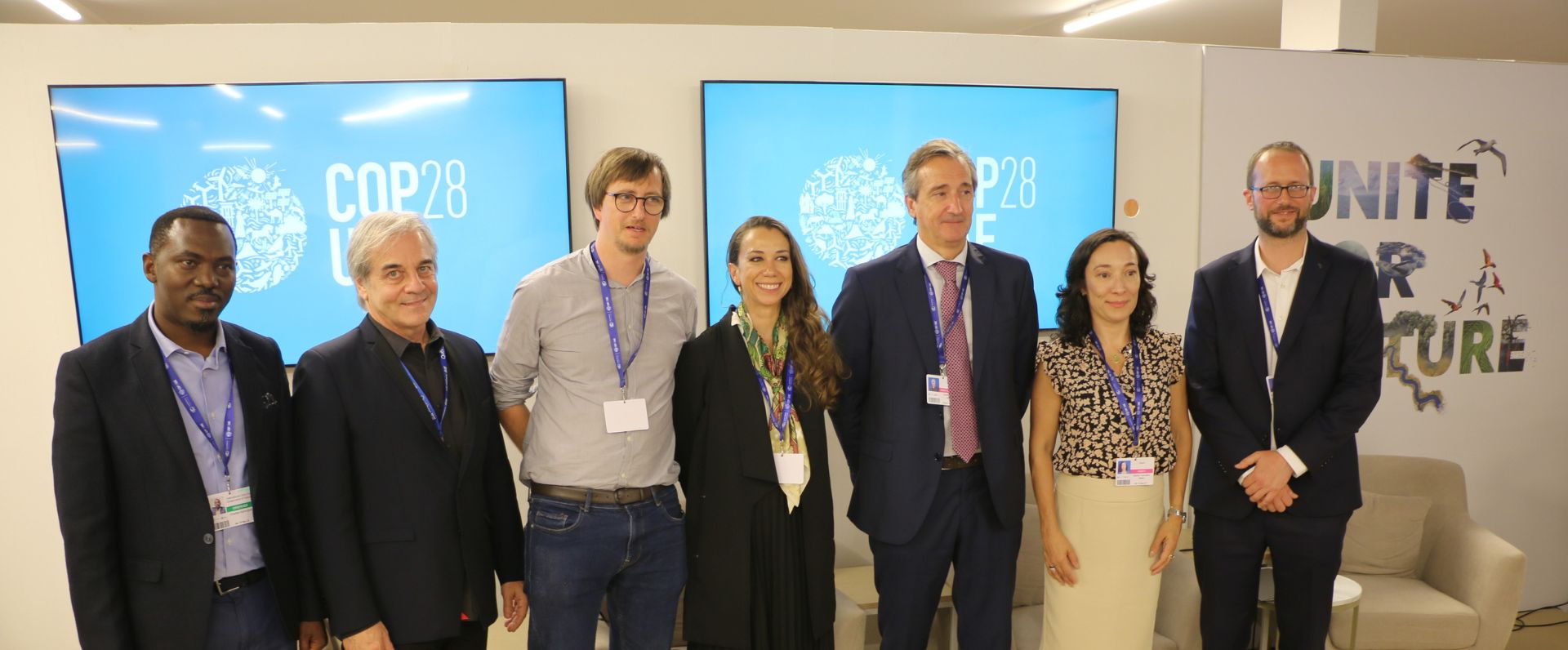
The event, entitled Catalysts of Change: Subnational Leadership on the Implementation of Innovative Nature-Based Solutions, gathered together leaders and policy makers from Quebec (Canada), Minas Gerais (Brazil), Baja California (Mexico), California (United States) and Catalonia, who together with the Basque Government's Natural Heritage and Climate Change Director, Adolfo Uriarte, have called for the alignment of the international climate agendas and biodiversity at territorial level, to address this two-fold planetary crisis, while constructing a prosperous and sustainable future for everyone.
The Basque Country, that is hosting the event, is a benchmark region in terms of climate adaptation by means of nature-based solutions. Along with similar regions, it remains interested in sharing experiences and creating synergies, particularly in the year of the Global Stocktake.
"We are therefore calling for the nature-based solutions implemented locally to be recognised and financially supported for faster action to address both the climate and the biodiversity crises, by directly contributing to international agreements such as the Paris Agreement and the Convention on Biological Diversity, stressed the Natural Heritage and Climate Change Director, Adolfo Uriarte, who opened the event.
The Basque Government, through Ihobe, its environmental management agency, has taken stock and gathered the most representative practices, organised into three sections: rivers, coasts and cities. "We currently have identified 63 projects with approximately 135 nature-based solutions implemented in Basque municipalities. In addition to recognising the good work that municipalities are doing, it is necessary to inspire other organisations in this regard, Uriarte explained.
Some of these solutions are focused on measures including purifying water with macrophyte plant for diverse populations (Etxabarri-Ibiña, Zigoitia), on river renaturation (Donostia, in addition to the actions promoted by URA), on greening cities (Bilbao), on green and blue rings to help connect the biodiversity (Vitoria-Gasteiz and Zarautz), on restoring urban marshlands to avoid river and coastal flooding (Bakio), and on restoring coastal habitats in periurban areas (Urdaibai and Txingudi), among others. "All these nature-based solutions are being implemented in small rural municipalities with 1,500 inhabitants, medium-sized municipalities with over 15,000 inhabitants, and also in the capitals of Basque Country, he pointed out.
In terms of financing these solutions, Uriarte stressed that "we, the different public administrations, and above all the regions and local authorities, are investing in running pilot projects and demonstrators, but we need other stakeholders, such as financial and private entities, as well as the European Union, to come into play in order to replicate those experiences".
The event, entitled Catalysts of Change: Subnational Leadership on the Implementation of Innovative Nature-Based Solutions, gathered together leaders and policy makers from Quebec (Canada), Minas Gerais (Brazil), Baja California (Mexico), California (United States) and Catalonia, who together with the Basque Government's Natural Heritage and Climate Change Director, Adolfo Uriarte, have called for the alignment of the international climate agendas and biodiversity at territorial level, to address this two-fold planetary crisis, while constructing a prosperous and sustainable future for everyone.
The Basque Government has pinpointed 63 projects with approximately 135 nature-based solutions implemented in Basque municipalities.
Innovative nature-based solutions are fundamental to tackle climate change and the loss of biodiversity, and concrete cases have been presented at the COP28 with the aim that they can be replicated to address both crises. The concept of nature-based solutions is relatively recent and refers to actions that use nature to provide solutions to different social and environmental challenges. It involves a broader intervention than protection or conservation. These nature-based solutions provide alternatives to specific problems or challenges, and apart from being sustainable, they are also mostly profitable, flexible and multi-use, as they generate numerous co-benefits.The Basque Country, that is hosting the event, is a benchmark region in terms of climate adaptation by means of nature-based solutions. Along with similar regions, it remains interested in sharing experiences and creating synergies, particularly in the year of the Global Stocktake.
"We are therefore calling for the nature-based solutions implemented locally to be recognised and financially supported for faster action to address both the climate and the biodiversity crises, by directly contributing to international agreements such as the Paris Agreement and the Convention on Biological Diversity, stressed the Natural Heritage and Climate Change Director, Adolfo Uriarte, who opened the event.
Adolfo Uriarte: "these solutions could reduce by up to 25% the expenditure needed to adapt to climate change and save around 360 billion euros globally by 2050"
In Uriarte's opinion, "these solutions could reduce by up to 25% the expenditure needed to adapt to climate change and save around 360 billion euros globally by 2050. The director emphasised that "we have equipped ourselves with instruments that favour its implementation, from generating knowledge by means of the innovative climate change adaptation projects of the Klimatek programme, to supporting their implementation by means of grants of local climate innovation through Udalsarea 2030, the Basque Network of Sustainable Municipalities.63 projects and 135 solutions
The Basque Government, through Ihobe, its environmental management agency, has taken stock and gathered the most representative practices, organised into three sections: rivers, coasts and cities. "We currently have identified 63 projects with approximately 135 nature-based solutions implemented in Basque municipalities. In addition to recognising the good work that municipalities are doing, it is necessary to inspire other organisations in this regard, Uriarte explained.
Some of these solutions are focused on measures including purifying water with macrophyte plant for diverse populations (Etxabarri-Ibiña, Zigoitia), on river renaturation (Donostia, in addition to the actions promoted by URA), on greening cities (Bilbao), on green and blue rings to help connect the biodiversity (Vitoria-Gasteiz and Zarautz), on restoring urban marshlands to avoid river and coastal flooding (Bakio), and on restoring coastal habitats in periurban areas (Urdaibai and Txingudi), among others. "All these nature-based solutions are being implemented in small rural municipalities with 1,500 inhabitants, medium-sized municipalities with over 15,000 inhabitants, and also in the capitals of Basque Country, he pointed out.
In terms of financing these solutions, Uriarte stressed that "we, the different public administrations, and above all the regions and local authorities, are investing in running pilot projects and demonstrators, but we need other stakeholders, such as financial and private entities, as well as the European Union, to come into play in order to replicate those experiences".
Source: Ihobe


