


Documentation
LIFE Platform Meeting on Climate Strategic Integrated Projects
Access YouTube



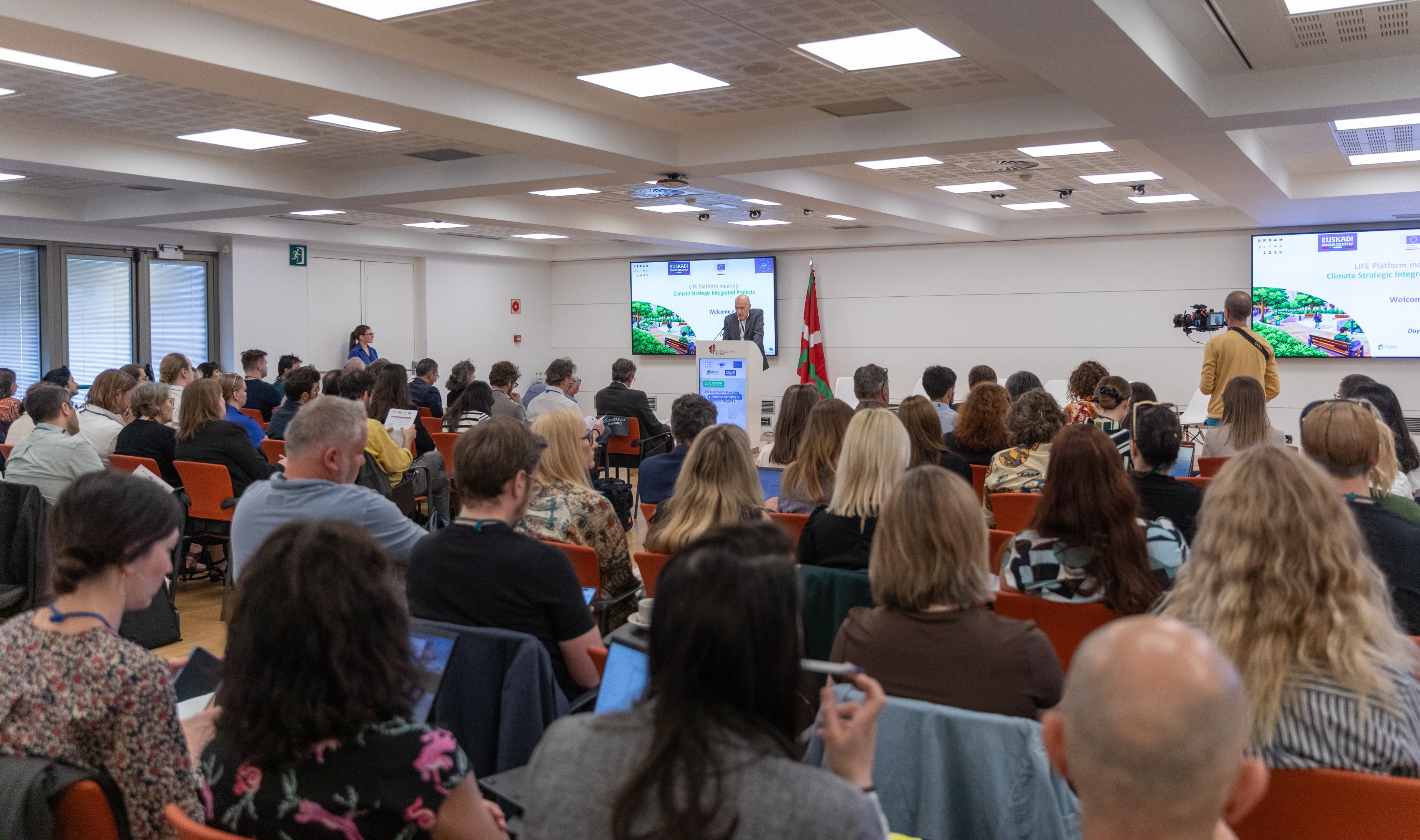
The LIFE IP Urban Klima 2050 project, led by the Basque Government's public company, Ihobe, is hosting the LIFE Platform Meeting on Climate Strategic Integrated Projects in Bilbao from today until 23 April. It is a European meeting that brings together the heads of 24 integrated and strategic projects from the LIFE Programme to share advances in mitigation and adaptation to climate change.
Alexander Boto Bastegieta, General Manager of Ihobe, has opened the meeting highlighting that after years of work, "the Basque Country offers an example of how to turn climate planning into specific actions in the region, through collaboration between administrations, stakeholders and technical knowledge, generating a real impact on the region’s resilience, with the LIFE Urban Klima 2050 project as an example". After his speech, Kurt Vandenberghe, Director-General of the European Commission’s DG CLIMA, has thanked the Basque Country for hosting this event via a video message and has emphasised that “in a time of geopolitical fragmentation, such as the one we are currently experiencing, and with mounting economic pressures, this kind of coordinated thinking and action to implement climate policies is more valuable than ever”.
The LIFE IP Urban Klima 2050 project, led by Ihobe, is acting as host and showcasing the Basque model of climate action based on governance, funding and action in the region
The opening programme has been rounded off with a speech by Adolfo Uriarte Villalba, the Basque Government’s Director of Natural Heritage and Climate Change Adaptation, who has talked about the LIFE IP Urban Klima 2050 project and also participated in the round table on governance, mobilisation of funds and capacity building.
Holding this LIFE Platform Meeting in the Basque Country highlights the work carried out in the region in terms of climate action. This work is based on a model that combines strategic planning, the development of pilot projects and collaboration between different public authorities and local stakeholders, as illustrated by the LIFE IP Urban Klima 2050 project, which has proven to be a key tool for deploying climate action in the Basque Country, by transferring energy and climate planning to specific actions in the region.
Through a multi-level and multi-stakeholder governance approach, Urban Klima 2050 has been able to integrate the vision and knowledge of public administrations, technology centres and local entities in a shared working model. This approach has led to the development of initiatives in coastal, river and urban areas to reduce the risk of flooding, increase the region’s resilience and adapt to the effects of climate change. Notable examples include interventions based on natural solutions in urban environments, measures taken along river courses and the development of climate risk monitoring and analysis systems.
The Urban Klima project, which is in its final year, has executed around 80% of the budget and has successfully completed 80% of its planned activities, making a significant contribution to the adaptation and mitigation of climate change in the Basque Country.
In addition to its environmental contribution and adaptation to climate change, the project is generating a positive impact on the Basque economic sector. According to the analysis of the socio-economic impact of LIFE IP Urban Klima 2050, during its first two phases (2019-2021 and 2022-2023), it has had an impact of around €7 million on GDP and helped to sustain around 100 jobs, thereby reinforcing its role as a tool to promote a climate transition with tangible effects on the region.
The meeting brings together 24 LIFE programme project managers in Bilbao from 21 to 23 April to share advances made in mitigation and adaptation to climate change
During the meeting, the European delegations will have the opportunity to see first-hand some of these LIFE Urban Klima 2050 initiatives, as the programme includes technical visits to interventions, such as the socio-environmental restoration of the Tonpoi area in Bermeo, or the flood protection measures in the River Estepona in Bakio through nature-based solutions for risk management. The programme will conclude with a visit to Bilbao, where actions in the area of María Díaz de Haro will be showcased as an example of the integration of nature-based solutions in urban planning.
After learning about the implementation of Basque initiatives in the field on the second day, the closing session will focus on the global challenges of climate action. Priorities include developing nature-based solutions to strengthen the resilience of the ecosystem and driving the energy transition and decarbonisation. In short, this Platform Meeting aims to serve as a networking opportunity for the leading integrated and strategic LIFE projects on climate action to continue building the Europe of the future: a more liveable, resilient and carbon-neutral continent, capable of withstanding the increasingly evident impacts of climate change.
The programme includes visits to demo sites in Bermeo, Bakio and Bilbao as examples of nature-based solutions and urban planning
Platform Meeting: a place to share knowledge and solutions
The event is part of the platform meetings promoted by the European Commission and the European Climate, Infrastructure and Environment Executive Agency (CINEA), which aim to promote knowledge sharing and collaborative learning among LIFE Strategic projects in the field of climate action.
The LIFE programme is the European Union's funding instrument for the environment and climate action and acts as a catalyst for the development and implementation of innovative solutions throughout Europe. Since 1992, it has co-financed more than 6,000 standard projects and since 2014 more than 100 strategic projects.
Source: Ihobe


