


- Climate change
The Basque Country turns seven years of climate action into a living laboratory to speed up adaptation
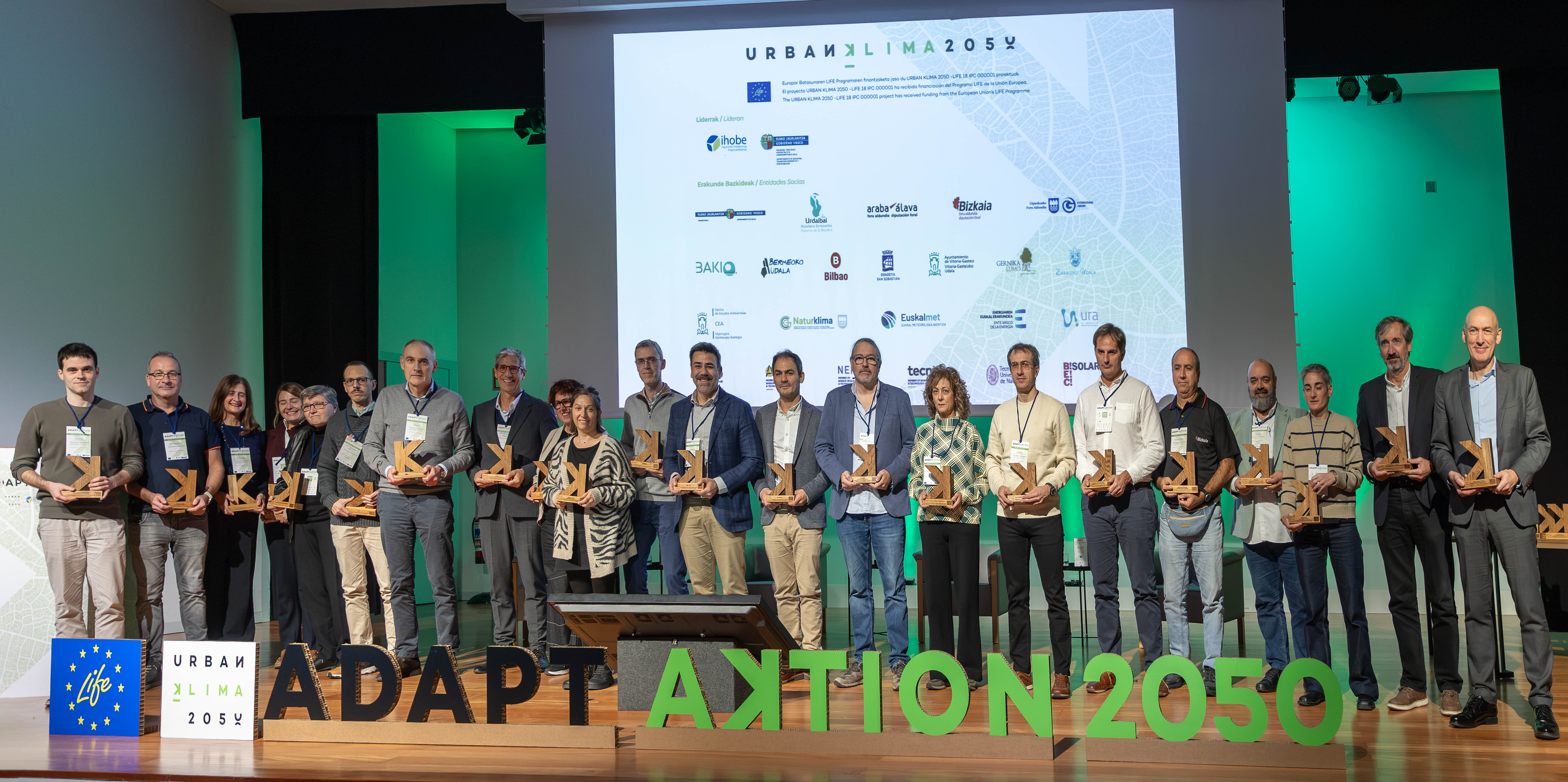
The Basque Country is entering a new phase in its response to climate change. After seven years of initiatives along the coast, in river basins and in urban areas, LIFE IP Urban Klima 2050 is drawing to a close, having installed capacities, tested solutions and built a collaborative network ready to speed up the region’s adaptation. That legacy and its continuity are at the heart of ADAPT AKTION Euskadi 2050, the forum that has brought together more than 150 specialists, institutional representatives, technical experts and European projects in Bilbao over the course of today and tomorrow.
The event was organised by the Basque Government’s Department of Industry, Energy Transition and Sustainability and Ihobe, and linked the results of the European LIFE Integrated Urban Klima 2050 project with the next generation of adaptation policies and projects in the Basque Country.
At the opening, Adolfo Uriarte Villalba, Director of Natural Heritage and Climate Change Adaptation for the Basque Government, pointed out that the project’s main value goes beyond the sum of its individual actions: “The most valuable legacy of Urban Klima 2050 cannot be summed up in a list of actions. It’s more about how we have learned to work.”
ADAPT AKTION Euskadi 2050 has brought together more than 150 specialists and institutional representatives in Bilbao to share solutions capable of responding to heatwaves, floods, droughts and coastal risks
In the LIFE IP Urban Klima 2050 project, multi-level governance took the form of a specific approach to organising climate adaptation: the Basque Government, through Ihobe, coordinated a project in which provincial councils, local councils and research and technology centres worked together on a common roadmap. This collaboration linked risk analysis to decisions on the ground. As a result, the project provided an updated assessment of vulnerability for Basque towns and cities and tested responses tailored to each location, such as creating an inland marsh and a floodplain forest in Bakio, and restoring the watercourse and riverbank vegetation on the River Errekatxulo, in Donostia/San Sebastian.
Uriarte advocated an approach based on cooperation, evidence and the ability to demonstrate results. “A good project does not end when its schedule comes to an end; it lives on through the capabilities it leaves in place,” he said. In this regard, he emphasised the fact that the project did not only coordinate actions, but also built trust between institutions with different areas of responsibility. This cooperation resulted in the creation of a Climate Change Hub, the foundation of the future climate observatory, which will gather information and guide public decision-making, “a space for sharing information, comparing what has been learned from pilot schemes and continuing coordination beyond the end of the project”, he said. Uriarte went on to argue that companies and the public should be more actively involved in decision-making and in the design of solutions.
Results of the LIFE URBAN KLIMA project
Over the seven years it was in operation, the LIFE Integrated Urban Klima 2050 project restored coastal, riverine and peri-urban areas to strengthen the Basque Country’s capacity to adapt to climate change. Among other results, the project’s final report shows that, according to cumulative data for 2025, more than 1,400 tonnes of CO₂ equivalent in emissions were prevented from being released into the atmosphere, and 4,265 MWh of energy was generated from renewable sources.
Over the seven years of the LIFE IP Urban Klima 2050 project, among other achievements, it has succeeded in recovering 2.7 hectares of coastal areas, 116 hectares of riverside forests and 25 hectares of degraded land in peri-urban areas, thereby strengthening the Basque Country’s capacity to adapt to climate change.
LIFE Urban Klima managed to regenerate 2.7 hectares along the coast, increase the area of riverbank woodland by 116 hectares, and rehabilitate 25 hectares of degraded land on the urban fringe, and the area managed under agroecological principles increased by 18.6 hectares.
The Basque Country puts itself forward as a European adaptation laboratory
The transition from accumulated knowledge to a new phase of climate action is taking shape in the Euskadi Climate Change Adaptation Living Lab. This proposal, presented by the Basque Government at COP31, puts the Basque Country forward as a living European laboratory for testing, demonstrating and transferring adaptation solutions that may prove useful to other towns, cities and regions.
“We want to put our region, our knowledge and our experience into use for testing and demonstrating solutions that may also be useful to other regions and territories,” said Uriarte.
Launched as part of the Basque Country Industry Plan 2030, the Living Lab will bring together public administrations, technology and research centres, companies and local entities to design, test and evaluate solutions in real-world conditions prior to their potential implementation on a larger scale.
To date, the Living Lab is made up of six demonstration projects aimed at responding to some of the region’s main climate risks. These initiatives include the adaptation of the metropolitan area around the Bilbao estuary, the regeneration of the Txingudi estuary, the adaptation of the Zarautz seafront, the restoration of the Bakio salt marsh and floodplain forest, the environmental restoration of the area around the River Zadorra in Vitoria-Gasteiz, and the creation of urban climate refuges in Legazpi.
The new Euskadi Climate Change Adaptation Living Lab has built on the work of six adaptation demonstration projects and turned the Basque Country into a European region where adaptation solutions can be designed, tested and transferred under real-world conditions
The initiative draws on much of the knowledge generated by LIFE IP Urban Klima 2050 and aims to speed up the implementation of innovative adaptation solutions capable of providing environmental, social and economic benefits, as well as new opportunities linked to innovation and the competitiveness of the Basque productive sector.
The presentation of these projects ties in with one of the main conclusions to emerge from the conference: the need to continue to move forward from the planning stage to the practical demonstration and implementation of solutions that are capable of generating knowledge that can be transferred to other towns, cities and regions.
Seven years of experience to share what we’ve learned
The results and lessons learned from LIFE IP Urban Klima 2050 are central to ADAPT AKTION Euskadi 2050. Over the past seven years, the project led by the Basque Government through Ihobe has implemented 40 initiatives involving 23 public and private entities, including the Basque Government (Department of Health, Directorate of Ports, Maritime Affairs and the Coast, and the Urdaibai Biosphere Reserve Trust), the three provincial councils, the town and city councils of Bilbao, Vitoria-Gasteiz, Donostia/San Sebastian, Bakio, Bermeo, Gernika-Lumo and Zarautz, various public companies belonging to the Basque Government and local authorities (Basque Water Agency – URA, the Basque Energy Agency (EVE) and BEC Solar, Euskalmet and CEA, the Centre for Environmental Studies of Gasteiz City Council), as well as technology and research centres (AZTI, BC3, Neiker, Tecnalia and Tecnun) and the Naturklima Foundation.
€20 million has been invested in actions that have carried out in strategic areas such as the coast, river basins and urban and peri-urban areas. In addition to the actions carried out, the project has helped to develop tools, methodologies and knowledge to incorporate climate change adaptation into public planning and management.
From knowledge to action
Throughout the morning, representatives from the European LIFE NAdapta, LIFE Garachico and LIFE City Adapt 3 projects shared their experiences in a discussion moderated by Alexander Boto, Director-General of Ihobe, during which various governance models were presented, along with mechanisms for transferring best practices between different European regions, with a view to determining what is required for a successful solution to be useful in other areas.
In the afternoon, three simultaneous sessions will give the audience an insight into the pilot projects carried out in the Basque Country. The experiences in Zarautz and Bermeo will be used to demonstrate coastal adaptation, while the initiatives in Araba, Donostia-San Sebastian and Bakio will show how to make more room for water in order to reduce the risk of flooding. At the same time, Tecnalia and BC3 will explain how renaturalisation can help urban and peri-urban environments cope with heat and heavy rainfall.
Meteorologist and science communicator Isabel Moreno Muñoz will open the final part of the day’s programme with a talk on how to communicate climate science clearly and accurately. Afterwards, Natalia Uribe Pando, Mari José Sanz Sánchez and Julen Rekondo Bravo will discuss the next steps to be taken following the failure to reach an agreement at COP31.
From debate to action on the ground
The event will continue on Wednesday 25 November, with three simultaneous technical visits in Araba, Bizkaia and Gipuzkoa, giving participants the chance to see some of the initiatives carried out as part of the LIFE IP Urban Klima 2050 project first hand.
In Araba, participants will visit the Jundiz Green Corridor, an environmental restoration project carried out in the area around the industrial estate, and the Ataria Interpretation Centre, where various adaptation initiatives implemented in Vitoria-Gasteiz will be presented, including projects relating to green infrastructure, agrobiodiversity and the improvement of urban comfort.
The Bizkaia visit will take visitors to the inland salt marsh and the floodplain forest of Bakio, a project aimed at improving flood resilience using nature-based solutions, and the Tonpoi site in Bermeo, which has been restored as peri-urban green infrastructure and opened up for public use.
The visit in Gipuzkoa will focus on the coastal adaptation measures carried out in Zarautz, in response to the risks associated with rising sea levels and heavy waves, and on the renaturalisation work on the River Errekatxulo in Donostia/San Sebastian, aimed at improving its ecological status and reducing the risk of flooding.
Source: Ihobe


