



- Ecodesign
- Ecoinnovation
The Basque Government and 14 basque companies join the states most significant public-private ecodesign and circular economy partnership
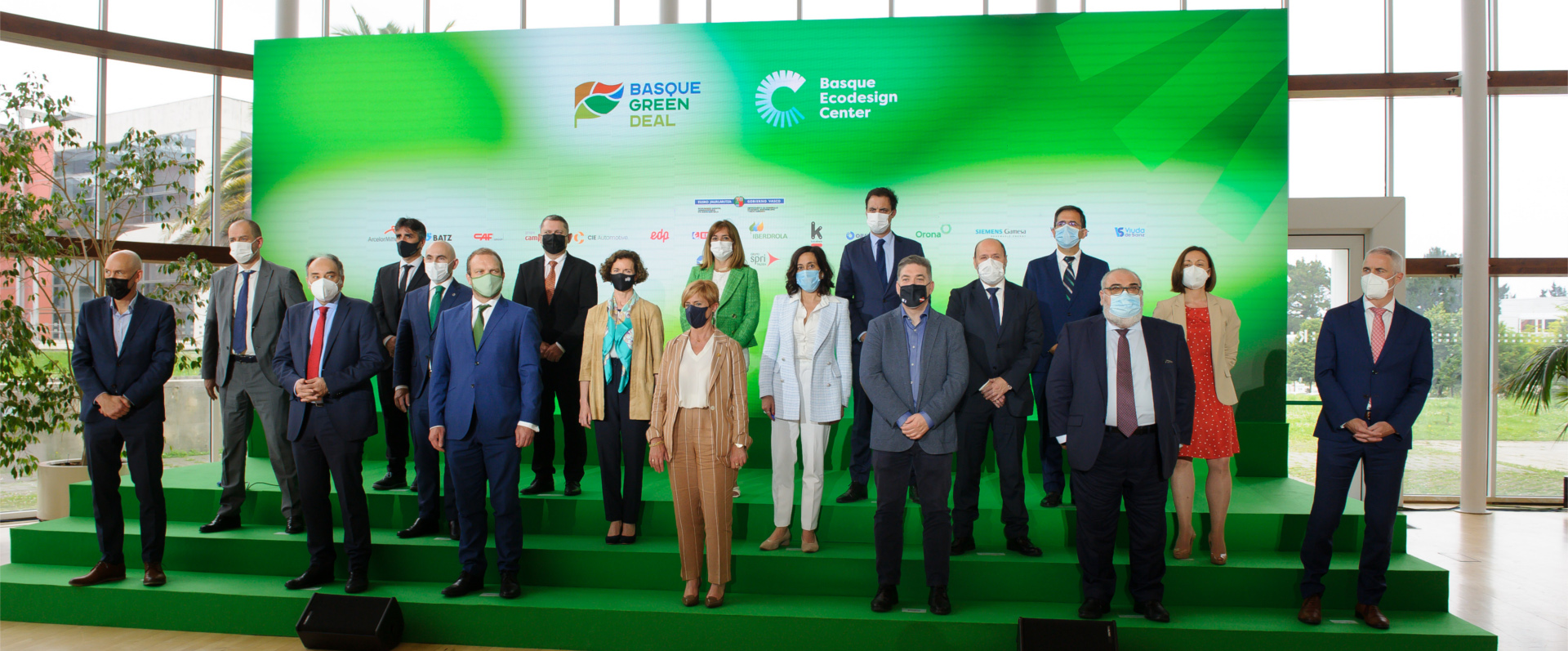
 Arantxa Tapia, economic development, sustainability and environmental advisor of the Basque Government, 14 Basque companies and public companies Ihobe and SPRI signed a public-private partnership agreement to develop ecodesign and the circular economy at the Basque Ecodesign Centre. The organisations involved are ArcelorMittal Sestao, Batz Group, CAF, CIE Automotive, EDP España, Eroski, Grupo Campezo, Iberdrola, Kutxabank, Ormazabal Velatia, Orona S.Coop, Siemens-Gamesa Renewable Energy, Vicinay Sestao, Viuda de Sainz, publicly-owned company Ihobe, SPRI and the Basque Government.
 The companies that make up the Basque Ecodesign Centre have an annual turnover of 59 billion euros, employ 148,000 people and have 103,000 suppliers
They signed the agreement this morning at an event attended by the Basque Countrys main economic players in Donostia/San Sebastian. Given the economic power of its members, the initiative will give a significant push to the Basque industrial sector to implement practices that comply with the strategy set by the European Green Pact and the Basque Green Deal.The alliance wants to transform the Basque industrial sector and put it in a strong position to face the environmental challenges of the next few years, said Tapia.
Under the collaboration agreement, which will run until 2025, the Basque Ecodesign Centre's member companies will work with the Basque Government to amass innovative knowledge about the circular economy for transfer to the rest of the Basque business sector. They will do this by developing projects that incorporate product life cycle into design and company management to stimulate the supply chain. In addition, new circular work systems will be piloted to generate changes in the production and consumption model.
They will also create a think tank with these companies, and the Basque Government will conduct an annual strategic reflection on challenges in the circular economy for the Basque business community. Based on this reflection, they will come up with recommendations to improve the Basque Country's environmental policy and companies will make high-level commitments.
Achieving a climate-neutral, circular economy in the Basque Country requires mobilising the entire industrial sector. It will take 25 years and a generation to transform an industrial sector and all value chains. If we want to be ready by 2050, we need to make decisions and take action within the next five years, said Tapia.
A tool to measure companies environmental footprint
To coincide with signing this agreement, the Basque Ecodesign Centre has presented a methodological guide and tool with which organisations can calculate their corporate environmental footprints. CIE Automotive, EDP, Iberdrola, and Vicinay Sestao have already taken this step.
The production of this guide by the Basque Ecodesign Centre is a clear commitment to put calculating the corporate Environmental Footprint at the heart of the transformation of the Basque business sector.
According to Tapia, this tool will enable companies to measure and report on their environmental impact throughout the value chain; establish medium- and long-term corporate objectives; identify critical points in processes from an environmental point of view and then reduce them by applying circular economy strategies, incorporating green purchasing criteria, both in the public and private sectors, so that they can make choices with lower environmental impact.
The Corporate Environmental Footprint is a measure of the environmental practices of companies that provide goods or services, that considers the entire life cycle. It provides detail information and quantifies the environmental processes and impact associated with the company's activities, identifying the main points of impact and defining the main options for environmental improvement.
The Corporate Environmental Footprint is a very appropriate method for monitoring improvements in companies environmental performance with regard to an internal or external objective, similar to how companies are performing in terms of their financial objectives. It is also be a very useful information for comparing the environmental performance of facilities and geographical areas within a company.
From an information point of view, the Corporate Environmental Footprint is a key reference for the environmental communication of companies towards their consumers, their investors, public authorities, and society in general.
The guide presented by the Basque Ecodesign Centre is designed to help the region's companies to calculate this environmental indicator as efficiently as possible. All kinds of companies can apply this methodology, as well as public administration entities, non-profit bodies and other types of organisations.
Source: Ihobe


