



BasquESG is the initiative driven by the Basque Government’s Ministry of Industry, the Energy Transition and Sustainability, its Ministry of the Treasury and Finance, and the Lehendakaritza (Basque Premier’s Office) to roll out a streamlined, common system aligned with Europe to allow Basque SMEs to assess, report and improve its performance in sustainability.
Its goal is to bolster the competitiveness of Basque industry, facilitate access to financing and to meet the growing demands for information from customers, large trailblazing companies and stakeholders of the value chain.
Apart from being an assessment system, BasquESG provides SMEs with added value by means of verified reporting, the development of a specific improvement plan and a benchmarking system that allows them to be compared to sectoral benchmarks, including the European average.

BasquESG seeks to provide the SMEs of the Basque Country with a common system that standardises the requests for sustainability reporting, streamlines the reporting process and prepares companies for an even more demanding European regulatory scenario. It makes it easier to respond coherently to the requests of large trailblazing companies, financial institutions and public administrations.
The BasquESG initiative uses the VSME voluntary standard as the basis for its assessment and reporting system as it is a tool developed by the European Commission that meets the real needs of SMES as it is designed specifically for their size, resources and capacities. This framework allows the required information to be standardised, the processes streamlined and the burden of multiple requests to be reduced; along with establishing a common language that fosters the relationship with large corporates and financial institutions. SMEs can therefore report their sustainability performance clearly, coherently and in line with European standards. This places Basque SMEs at an advantage in terms of the challenges and opportunities of the sustainable transition.
BasquESG supports the SMEs of the Basque Country in their transformation towards sustainability; to that end, it has set these goals, namely to:
-
Make the industrial SMEs of the Basque Country more competitive with a comparable, reliable assessment system that is in line with European standards.
-
Meet the financing and value chain needs by providing standardised ESG information for customers and financial institutions.
-
Align the SMEs with European directives by means of using the VSME standard and their participation in the EFRAG-driven European community.
-
Provide value beyond the assessment with verified reporting, actions plans and sectoral benchmarking tools.
-
Drive incentives and momentum by means of access to financial instruments, championing green public procurement and working with trailblazing companies.
More than an assessment system
BasquESG goes beyond being merely assessing sustainability and generates tangible value, by turning reporting into a continuous improvement tool. To that end, it helps with:
Generating verified sustainability reporting.
Defining an improvement plan that turns reporting into a tool to strengthen the sustainability of the organisation.
Providing rating and benchmarking tools that show the progress and the competitive position compared to other companies.
Access to incentives and support, including financial instruments, traction programmes in the value chain, inclusion of green public procurement criteria.
The BasqueESG initiative brings together all the stakeholders that are involved in the sustainability reporting of the SMEs, to thus ensure the coordination, coherence and vision of all the parties.
The driving force is the Basque Government through its Strategic Committee, working with an Operations Committee – consisting of a dynamic network of large trailblazing companies and financial institutions that can join as partners at any time – a Technical Secretariat, along with the External Advisory Panel, thus strengthening cooperation and the sharing of sustainability information.
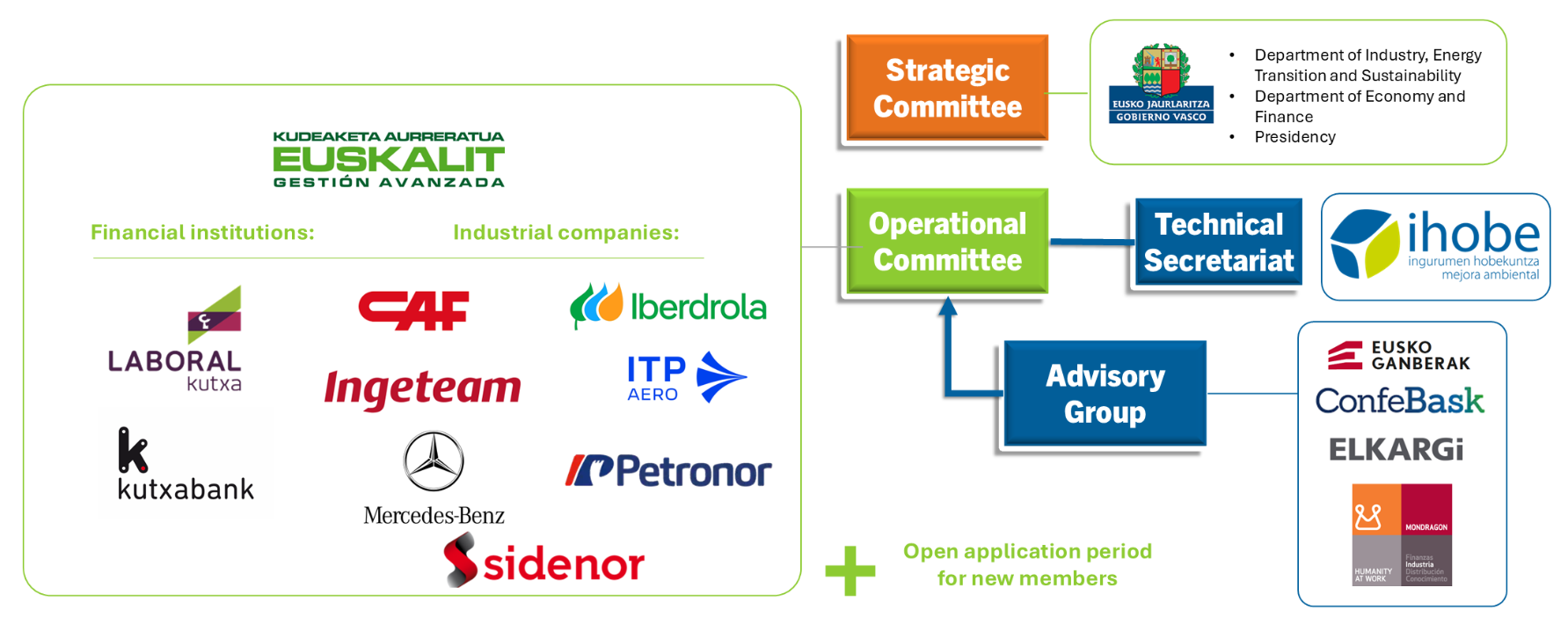
It is the political leadership body and driving force of the initiative. It defines the general strategy and establishes the priorities of BasquESG. It is chaired by the Basque Minister for Industry, Energy Transition and Sustainability and is made up by the respective Basque Government ministries.
| Members |
Basque Ministry of Industry, the Energy Transition and Sustainability
 |
|
Basque Ministry for the Treasury and Finance
|
|
|
Lehendakaritza (Basque Premier’s Office)
|
The Technical Secretariat supports both the Strategic Committee and the Operations Committee. It is run by Ihobe, whose remit includes the planning, management, coordination and organisation of initiative activities as per the guidelines of the Strategic Committee.
| Incumbent |
Ihobe
 |
The Operations Committee is the technical body managing the initiative. Its remit is to oversee the rolling out of project, coordinate the participants and to ensure the implementation of the defined actions. It answers to the Basque Government’s Circular Economy Directorate.
| Members |
Euskalit
 |
|
Banks
Kutxabank
 Laboral Kutxa
 |
|
|
Business/Industry
CAF
 Iberdrola
 Ingeteam
 ITP Aero
 Mercedes-Benz
 Petronor
 Sidenor
 |
It is a technical taskforce, consisting of business associations and organisations of the Basque Country and intermediaries of SMEs. It makes recommendations regarding sustainability and good practices, fostering the uptake of ESG principles as a factor for business competitiveness.
| Members |
Eusko Ganberak
 |
|
Confebask
 |
|
|
Elkargi
 |
|
|
Mondragon
 |
BasquESG has Basque SMEs at the centre of the initiative; it drives their participation through support and training actions run by Euskalit, the entity tasked with rolling out those services among the SMEs.
The initiative includes the following activities to support SMEs in their sustainability improvement and assessment process:
| Awareness-raising | Capacity-building | Mentoring |


Advantages of participating in the initiative
Participating in BasquESG provides SMEs with a series of strategic and practical benefits:
-
Access to a clear system aligned with Europe, based on the VSME standard, which is recognised and championed by the European Commission. This framework simplifies sustainability reporting and reduces the bureaucratic burden.
-
Better respond to the requests from customers, financial institutions and other stakeholders of the supply chain. The system standardises the information required by large trailblazing companies and financial institutions, thus facilitating commercial relations and compliance of the external demands.
-
Greater competitiveness and better positioning. Companies obtain a clear analysis, an action plan and the possibility to compare their performance with similar companies, thus bolstering their capacity to compete on more demanding markets.
-
Receive specialised Euskalit mentoring. The SMEs are provided with training, awareness-raising, technical support and external verification, by ensuring the quality and effectiveness of the sustainability assessment and reporting process.
Phases of the initiative
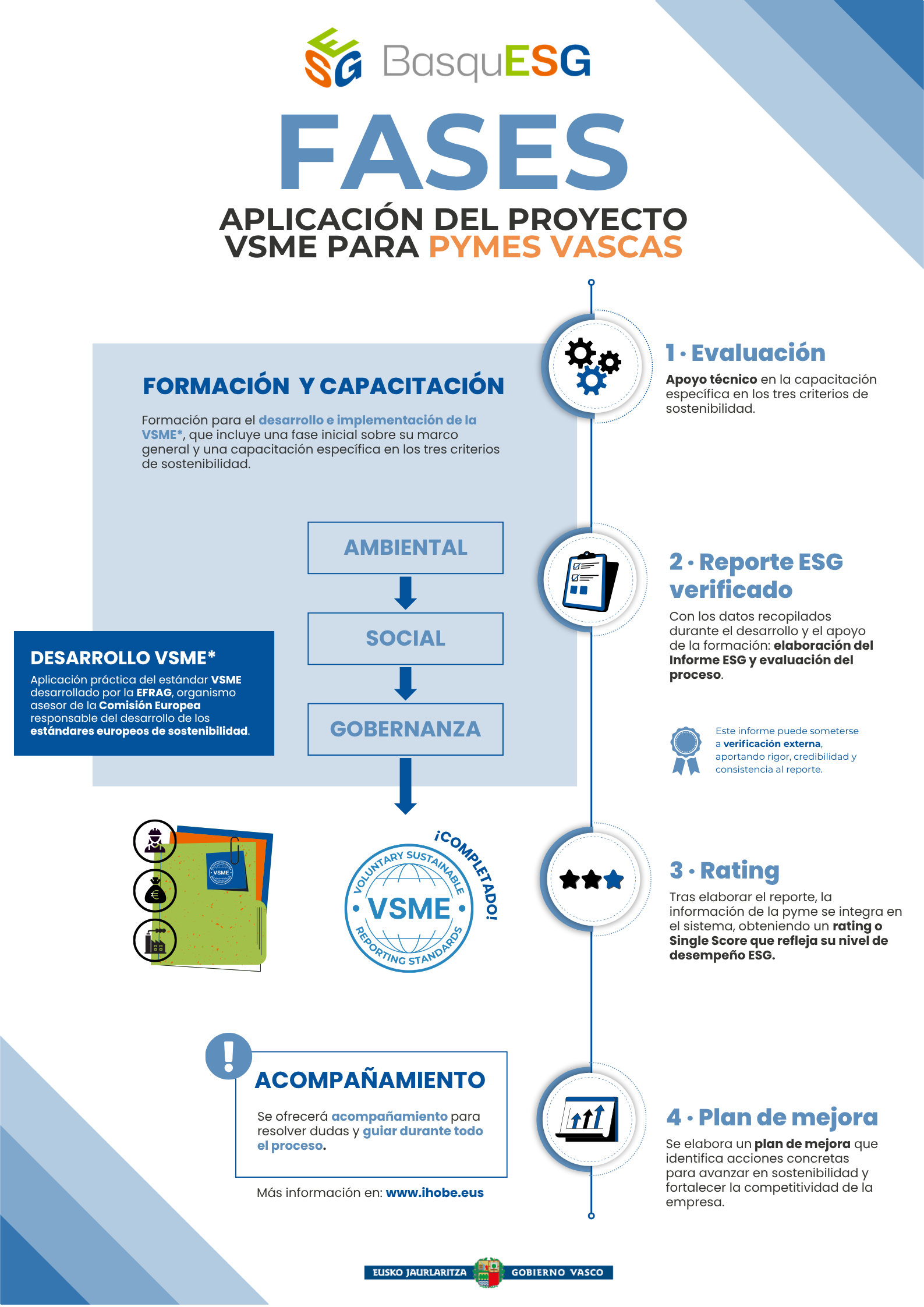
The participation of an SME in BasquESG follows a process structured into several phases that enable the SME to progress from the initial understanding of the system to preparing full ESG reporting:
-
Sustainability assessment: The sustainability performance of the SME is assessed based on environmental, social and governance criteria according to the VSME standard. The data compiled during this phase will be progressively integrated in the BasquESG tool, once available.
-
Preparing the ESG Reporting: Using the data obtained during the preliminary phase, the SME prepares its ESG Report, which includes the assessment of the performance in each of the areas of the standard. This phase involves the effective integration of the VSME model in the organisation.
-
Verification of the ESG reporting: The report can be subject to external verification, by providing rigor, credibility and consistency to the information reported within the BasquESG system.
-
Rating (Single Score): Once the reporting has been verified and the information integrated in the system, the company can obtain a rating or Single Score designed and implemented by Ihobe, which will reflect the SME’s level of ESG performance and will facilitate the interpretation of the results.
-
Preparing the Improvement Plan: The obtained results are used to prepare an improvement plan that identifies prioritised and specific actions to advance in sustainability and make the company more competitive.
How to take part
Participation in the project is free of charge for any Basque SME interested in being part of Basque ESG. Companies that wish to join the new call may do so by completing the participation form.
Pilot phases
BasquESG has begun to be rolled out by means of several pilot project aimed at assessing their effectiveness in a real environment and at mentoring the first SMEs in the uptake of the VSME standard.
This first cycle of the initiative will allow:
-
The real applicability of the VSME standard in the Basque Country to be checked, by assessing how it adapts to the capacities, resources and needs of the industrial SMEs.
-
The tools, processes and support materials to be adjusted, guaranteeing that the system is clear, operational and accessible for all organisations.
-
The definitive rolling out of the BasquESG initiative to be prepared for all Basque SMEs, while ensuring a progressive, robust implementation in line with European guidelines.
Those pilot projects are the first step for building a common ESG assessment and reporting system in the Basque Country, based on working with companies and aimed at generating a robust, user-friendly and useful model for the whole of industry.
