



The whole of the Pyrenees, including the Basque Country, is embarking on a large cross-border project to prepare the territory for climate change
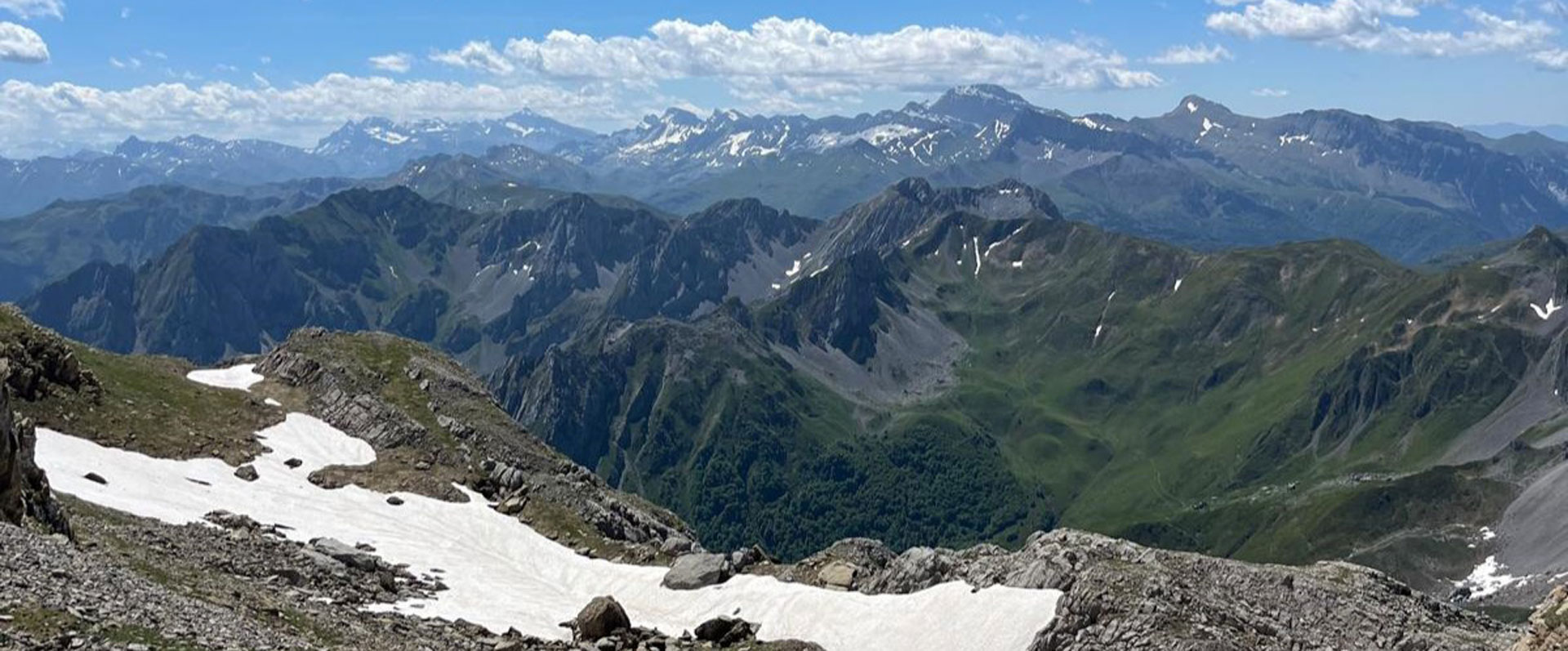
The Pyrenees and the whole of its biodiversity are threatened by climate change, and the effects can be seen at a faster rate than in other regions: according to the scientific community, the temperature in the Pyrenees has risen by 30% over the planet's global average in the last six decades. This situation requires urgent and far-reaching action, and ignoring borders. That realisation has led to the European LIFE PYRENEES4CLIMA 'Towards a climate-resilient cross-border mountain community in the Pyrenees 2024-2031' project; involving six regions of Spain and France (the Basque Country, Navarra, Aragón, Catalonia, Occitanie and Nouvelle-Aquitaine) and the state of Andorra.
PYRENEES4CLIMA will run 33 demonstration case studies, practical examples of Europe's first cross-board climate change strategy in a mountain area
Coordinated by the Pyrenean Climate Change Observatory (OPCC) of the Working Community of the Pyrenees (CTP), the project will deploy Europe's first-border climate change strategy in a mountain area, the EPiCC (Pyrenean Climate Change Strategy). It will be implemented at local level: in fact, opting for specific intervention in the territories of the Pyrenean bioregion is one of its great values. Therefore, over the coming seven years, 33 demonstration studies for climate change adaptation will be undertaken, thanks to this cross-border collaboration between seven Pyrenean territories. In total, 46 entities of those territories will deploy a common action, aimed - through different core areas - to strengthen resilience in the Pyrenees by applying adaptation measures. The budget is nearly 20 million, 60% of which will be financed by EU LIFE funds. 
Two pilot schemes in the Basque Country
The project's pilot schemes will act in five areas to achieve adaptation: understanding climate impacts; making natural areas more resilient; adapting the mountain economy; protecting the population and territory against natural-climate risks; and driving innovative climate governance involving citizens, the socio-economic sectors, the scientific community and policy markets.
Two of the pilot schemes will be run in the Basque Country; they will address aspects of the adapted mountain economy and how to improve climate knowledge and understanding
The project's partners in the Basque Country are Ihobe, representing the Basque Government as its environmental management agency; the Neiker technology centre; BC3-Basque Centre For Climate Change-Klima Aldaketa Ikergai; Gipuzkoa Climate Change Foundation-Naturklima; and HAZI Fundazioa, the latter through FORESPIR. Other cross-border and local entities will help with the running of these schemes.
Specifically, two pilot schemes in two of those areas will be implemented in the Basque Country. The first is focused on the mountain economy, and will be implemented in the Montaña Alavesa zone. Led by Fundazioa through HAZI Fundazioa, it will involve bolstering the timber/forest value chain to improve the adaptation of the sector and the forests' development to climate change. The aim is to test, promote and deploy an approach that includes forestry management close to the natural processes and takes into account the multi-purpose nature of the forest, establishing a dialogue and action between the pre- and post-parts of the timber industry and encouraging the use of local wood as a real solution for the future. Those same actions will be carried out in a further four areas of the Pyrenees by applying mutual learning and transfer methodologies. 
The second will be focused on supporting the economic sectors most affected by climate change, within the scope of climate knowledge and evolution. Specifically, climate change indicators will be created and validated by means of a consultation processes of different stakeholders in the Basque Country, with the focus - above all - on the primary sector. Led by Naturklima, the results will be presented along with the Pyrenean Ecology Institute (IPE-CSIC), Météo France and the Servei Meteorològic de Catalunya, the French and Catalan met offices respectively. The aim is to pinpoint those indicators that really contribute useful information to this sector; specifically, for mountain agriculture, livestock farming and forestry management. A manual will be prepared that explains the established process, including a specific datasheet for each indicator with its definition, its benchmark value and its usefulness. The list of all climate change indicators that can be calculated in the Pyrenees - based above all on temperature and precipitation evolution - is already available. The consultation work, with the involvement of local levels, is planned for January 2027.
About EPiCC
The LIFE PYRENEES4CLIMA project will deploy the Pyrenean Climate Change Strategy (EPiCC), the first of its kind in Europe. It is a cross-border climate change strategy in a mountain area, led by the seven Pyrenean territories, belonging to three different States, and defined by means of a participation process throughout the mountain range.
Iturria:Ihobe


