



2026ko maiatzaren 22a
- Ingurumen-komunikazioa
Registration for the 2023 Environmental Communication School, with a focus on the environment and youth, is now open
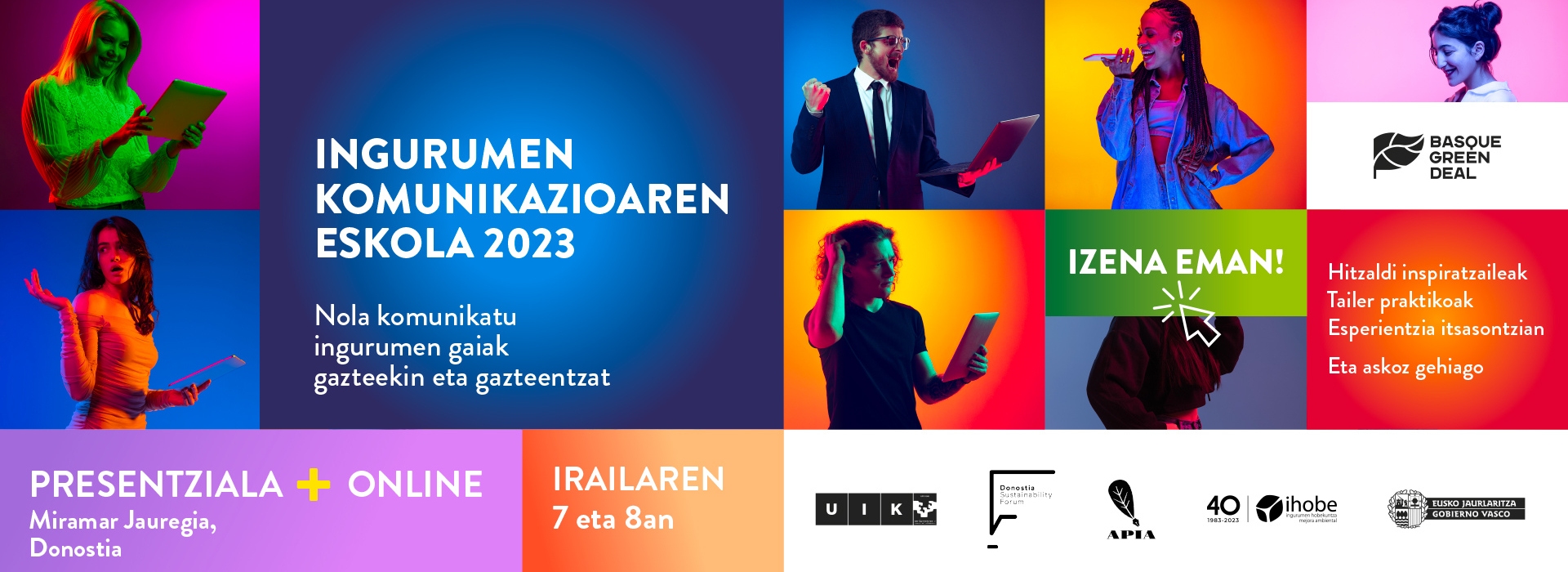
It will be organized by Ihobe - the Public Environmental Management Society of the Basque Government - and APIA - the Association of Environmental Information Journalists, held on September 7th and 8th
The Environmental Communication School is a forum for debate that was born in 2019 with the objective of generating a space for reflection on the communication of major environmental challenges, offering key insights to address topics such as the climate crisis, biodiversity loss, nature conservation, circular economy, and sustainable development, among others. Under the title How to communicate environmental issues with and for young people, the fifth edition will focus on young people and how environmental issues are communicated from different channels and networks, and how their message reaches and attracts peers.The fifth edition of this school, held within the framework of the Summer Courses of the University of the Basque Country and the Donostia Sustainability Forum, will centre around environmental communication with and for young people
During the school, topics such as what motivates young people and where they can be reached, how we can address the climate crisis and other environmental challenges, good environmental practices through social media, how the human brain works and how to activate it with the right messages, and new formats, platforms, and channels for environmental communication will be discussed. The intention is for participants to acquire useful knowledge to effectively communicate environmental issues to young people, so that they can understand their importance and take measures to protect the environment.To this end, the School of Environmental Communication 2023 will have an eminently practical and exchange approach. It will offer the opportunity to learn from young people, main characters in this edition, who will tell their experiences in the first person. In this way, participants will be able to learn about good practice cases that can inspire both communication professionals and other stakeholders interested in delivering environmental information to young people.
A youth-led programme
Young environmental communication professionals will be the main characters of the program on both days, which will take place at the Miramar Palace in San Sebastian in a hybrid format, allowing for both in-person and online participation. The opening, on September 7, will be chaired by Amaia Barredo, Deputy Minister of Environmental Sustainability of the Basque Government, accompanied by the president of APIA, María García de la Fuente, and the director of the course, Yolanda Rodriguez, responsible for Communication of Ihobe.
Among the teachers of that first day are young people such as Javier Clemente, responsible for Todos Somos Reciclaje, who has titled his presentation 'How to communicate about the environment on social media without giving up.' It will be followed by a round table discussion on new ways of communicating through social media featuring renowned specialists in environmental communication, such as Cristina Monge, political scientist, analyst and researcher in Governance for Ecological Transition; Laura Peinado, creator of content on sustainability; in addition to the environmental disseminator Diego Ferraz-Castiñeiras, Ecodiuku. Later on, there will be a talk with Belén Hinojar and Carmen Huidobro, a creative and an environmentalist respectively, who are responsible for Climabar, a sustainability and ecology outreach project with a strong presence on social media.
The program will be completed with a practical workshop and an experience during the afternoon of September 7. Those attending in person will have the opportunity to visit Pasaia and board the ship MATER Ecomuseoa, and to learn about their on-site methods of disseminating information about the protection of marine ecosystems. Remote attendees, on the other hand, will have a film forum led by David Sánchez Carretero, director of CIMASUB, the International Cycle of Underwater Cinema of Donostia-San Sebastián.
The second day, on September 8, will open with a keynote speech by María Del Carmen Aguilar-Luzón, president of the Association of Environmental Psychology-PSICAMB, which will explain how to generate climate awareness in young people, and how emotions can help transmit a message of change.
It will also be possible to learn about the creation of the most followed Spanish media outlet on TikTok, AC2ALITY, through a presentation by its founder, Daniela Álvarez.
Finally, the summer course will offer two workshops. The first one will focus on podcasting, with María José Montesinos, director of the Por Naturaleza podcast of RNE Aragón. The second one will be led by Maribel Ángel-Moreno, a journalist from Maldita.es, and will focus on Twitch.
About the School
The Environmental Communication School is one of the activities included in the programming of the Summer Courses of the University of the Basque Country-UPV/EHU and is also part of the Donostia Sustainability Forum, a forum for interdisciplinary approaches to sustainability from social, environmental, and economic perspectives.
The Environmental Communication School, organized by Ihobe-Public Environmental Management Company of the Basque Government and APIA-Environmental Information Journalists Association, is a forum for discussion that advocates for the role of communication as a tool to mobilize action. In the first edition of 2019, the focus was on communicating the climate crisis; in the second, communication on biodiversity and natural heritage was addressed; the third edition, in September 2021, was dedicated to the energy and climate transition; and the fourth edition was addressed to the relationship between the climate crisis, ecosystem conservation and human health.
The fifth edition of the School, which will focus on how to communicate environmental issues with and for young people, will be held on 7 and 8 September both in person and on-line at the Miramar Palace in Donostia. Registration is now open and can be done at the following link: https://www.uik.eus/es/curso/como-comunicar-temas-ambientales-con-personas-juvenes
Iturria:Ihobe


